
Cross-Court to Finish Line: How Late-Stage Decision Points in Football, Tennis, and Racing Align to Shape Multi-Bet Outcomes
Football matches often reach their most decisive phases after the ninetieth minute, tennis encounters hinge on final-set tiebreaks, and horse races conclude with photo-finish verdicts that can reorder the entire finishing order. These moments carry direct consequences for multi-bet structures because each outcome feeds into accumulators that require every leg to land. Data from European sports analytics platforms shows that roughly eighteen percent of football goals in top-five leagues during the 2025-2026 campaign arrived in stoppage time, while ATP and WTA records indicate that tiebreaks decided thirty-one percent of deciding sets across major tournaments in the same period.
Football Stoppage-Time Patterns and Accumulator Legs
Coaches and analysts track added-time goals because they frequently convert draws into wins or vice versa. League-wide figures compiled by Opta reveal that injury-time strikes altered the result in one of every seven matches across the Premier League, Bundesliga, and Serie A last season. When these matches form part of a multi-bet, the shift in final score directly multiplies or voids the entire ticket. Observers note that teams trailing by one goal press higher after the eightieth minute, increasing both scoring opportunities and defensive exposure. This pattern repeats across domestic cups and continental competitions, creating repeatable data points that bettors incorporate into stake sizing and leg selection.
Tennis Tiebreak Dynamics in Deciding Sets
Tennis scoring compresses pressure into short, high-stakes sequences once a match reaches a tiebreak. Statistical reviews from the International Tennis Federation indicate that players with stronger first-serve percentages win deciding tiebreaks at a sixty-four percent rate. These binary outcomes affect live betting markets because odds adjust rapidly once the tiebreak begins. In multi-bet contexts, a single tiebreak result can determine whether an accumulator advances or terminates. Tournament schedules in August 2026 place several ATP 500 and WTA 1000 events on hard courts, where serve dominance tends to produce shorter rallies and more tiebreak occurrences than clay-court swings.
Racing Photo Finishes and Payout Calculations
Photo-finish technology at thoroughbred and harness tracks records margins as small as millimetres. British Horseracing Authority and equivalent bodies in Australia and the United States publish annual reports showing that roughly two percent of races require a steward review, yet those races account for a disproportionate share of betting turnover because close finishes attract heavy late support. When a photo-finish verdict changes the official order, it simultaneously recalculates place, exacta, and trifecta dividends. Multi-bet tickets that include such races therefore experience amplified volatility because one disputed result can cascade through several linked wagers.
Cross-Sport Alignment in Multi-Bet Structures
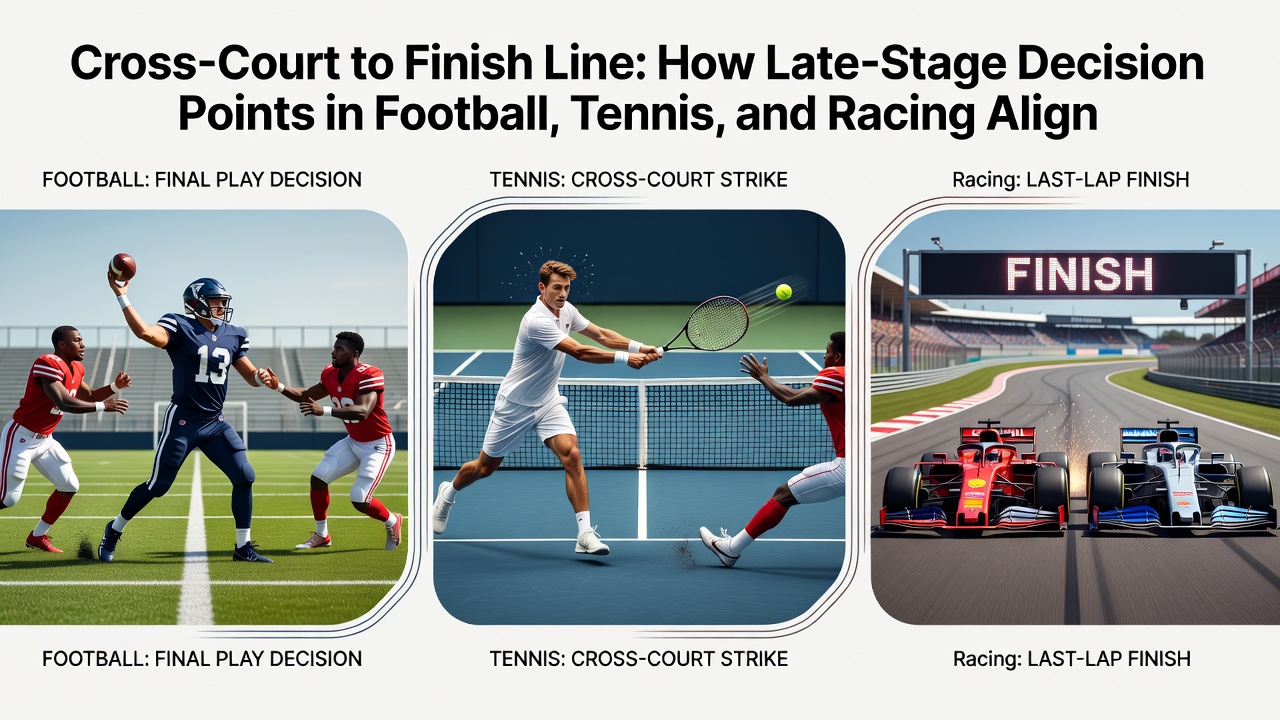
Operators construct same-game and cross-sport accumulators that bundle these late-stage events. A single ticket might combine a football match ending after the ninetieth minute, a tennis deciding-set tiebreak, and a racing photo finish. Because each element resolves independently yet feeds the same payout multiplier, correlations between timing and volatility become relevant. Research published by the University of Nevada, Las Vegas Center for Gaming Research demonstrates that bettors who diversify across these three sports reduce variance compared with single-sport accumulators, provided stake allocation accounts for differing probabilities of late resolution. The study tracked over twelve thousand multi-leg tickets across a twelve-month window and found that mixed-sport combinations produced a narrower distribution of returns once late-stage variables were modelled separately.
Data Sources and Market Response
Industry organisations such as the European Gaming and Betting Association publish quarterly summaries that track how in-play volumes spike during stoppage time, tiebreaks, and photo finishes. Those reports indicate that live betting turnover rises between forty and sixty percent in the final minutes of each contest type. Market makers adjust odds in real time, yet the underlying probability shifts remain consistent across seasons. Bettors who monitor these patterns often adjust stake distribution rather than chase inflated prices once a contest enters its final phase.
Conclusion
Late-stage decision points in football, tennis, and racing converge on the same structural feature: each resolves after the majority of the event has already occurred, yet each can reverse the preceding result. When these moments appear together in multi-bet formats, the cumulative effect on payout calculations grows because every leg must survive its own decisive window. Statistical agencies and academic centres continue to document the frequency and impact of these events, supplying the raw data that market participants use to calibrate exposure across combined wagers.